Xiaomi 17 Pro Max vs iPhone 17 Pro Max (2025): Full Specs, Real-World Differences, and Which to Buy
TL;DR:
If you want the wild-feature flagship—huge battery, super-fast charging, Leica-tuned cameras, and a rear mini display—the Xiaomi 17 Pro Max is the exciting pick. If you need polish, global availability, class-leading long-range camera reach (8×/200 mm), and the iOS ecosystem, the iPhone 17 Pro Max is the safer all-rounder. Read on for a deep dive into display, cameras, performance, battery life, charging, software, prices, and who each phone is actually for.
Table of Contents : Xiaomi 17 Pro Max vs iPhone 17 Pro Max
At-a-Glance Specs (Quick Scan)
| Xiaomi 17 Pro Max | iPhone 17 Pro Max | |
|---|---|---|
| Platform | Snapdragon 8 Elite Gen 5 | A19 Pro |
| Display (front) | LTPO OLED, 120 Hz, up to ~3,500 nits peak | 6.9″ Super Retina XDR OLED, ProMotion 120 Hz, up to ~3,000 nits outdoor |
| Extra screen | Rear mini OLED in camera island | — |
| Cameras (rear) | 50 MP ×3 (Leica), incl. 5× periscope | 48 MP ×3, 8× optical-quality reach (≈200 mm eq.) |
| Front camera | High-res selfie, rear display allows rear-cam selfies | 18 MP Center Stage front camera |
| Battery | 7,500 mAh (silicon-carbon) | Not disclosed; strong real-world endurance gains |
| Charging | 100W wired / 50W wireless | Faster than last gen; ~40W supported (charger sold separately) |
| Software | HyperOS 3 (Android 16) | iOS 26 + Apple Intelligence |
| Water resistance | IP68 (model-dependent) | IP68 |
| Availability | China first; global TBD | Global retail; from $1,199 (varies by region) |
Note: exact panel sizes, storage/RAM options, and band support vary by region/trim. Always check the SKU you’re buying.
Design & Displays
Xiaomi 17 Pro Max
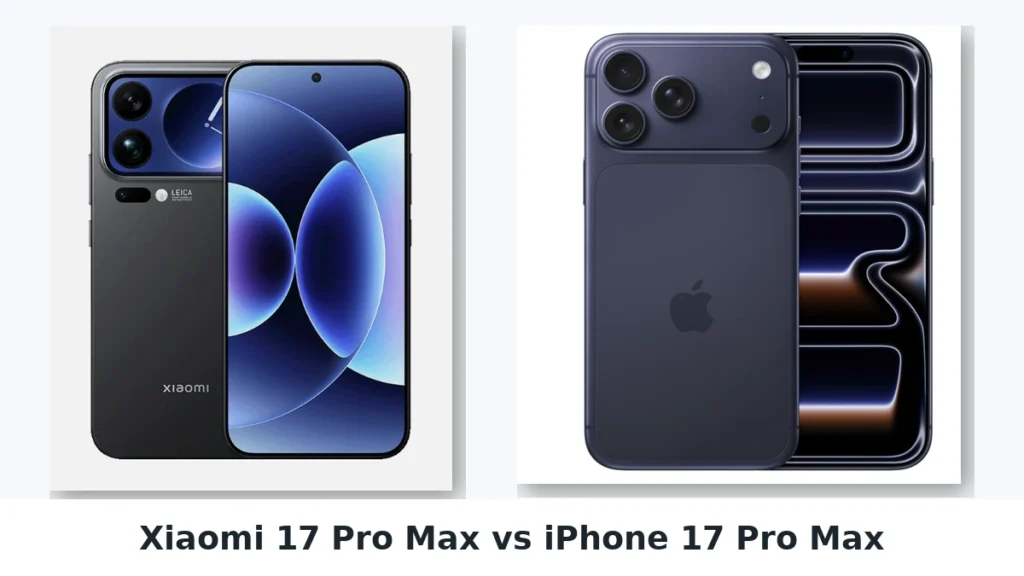
Xiaomi leans into bold hardware. The front is a modern LTPO OLED (120 Hz) with a very high peak brightness (~3,500 nits) for outdoor legibility. What sets it apart isn’t the front—it’s the secondary mini OLED on the back, integrated into the camera island. This rear display serves quick glances (time, notifications, music controls) and doubles as a viewfinder for rear-camera selfies, effectively turning the main array into an ultra-high-quality selfie rig.
Build is premium, with tight tolerances and a reassuring hand feel. The new battery chemistry means the phone stays surprisingly manageable considering its 7,500 mAh pack.
iPhone 17 Pro Max
Apple’s redesign focuses on unibody aluminum (heat-forged) with a vapor chamber for better thermal efficiency. The result is a rigid, refined chassis that disperses heat more evenly while keeping the minimalist Apple aesthetics. The screen is a 6.9″ Super Retina XDR with ProMotion 120 Hz and ~3,000 nits outdoor peak—extremely bright, color-accurate, and consistent.
There’s no rear screen here; Apple sticks to a single-display philosophy and invests effort in calibrated color, peak HDR brightness, and excellent touch/scroll smoothness.
Verdict:
- Want novelty + utility? Xiaomi’s rear mini display is genuinely useful for selfies, quick controls, and battery-saving checks.
- Prefer ultra-refined execution and a massive, color-faithful canvas? The iPhone’s 6.9″ ProMotion panel and unibody build deliver a no-compromise daily driver feel.
Cameras: Hardware, Consistency, and Reach
Xiaomi 17 Pro Max (Leica-tuned)
- Rear array: 50 MP ×3 with a 5× periscope telephoto.
- Strengths: Leica color profiles, flexible focal lengths, and rear-screen selfies (use the best sensors for portraits/vlogging). Users chasing stylized color science tend to love Xiaomi/Leica rendering, especially in street and portrait work.
- Low light: Computational night performance is strong; periscope helps maintain detail at longer focal lengths.
- Video: Robust 4K/8K options, wide control in Pro/LOG modes depending on region and app support.
iPhone 17 Pro Max
- Rear array: 48 MP triple with Apple’s longest reach yet—8× optical-quality at 200 mm equivalent.
- Strengths: Reliability. Colors, white balance, and exposure are consistent across lenses. For video, Apple keeps the crown with pro-grade features (ProRes, advanced stabilization, Dual Capture, RAW/LOG profiles, Genlock in pro workflows).
- Low light: iPhone’s Night and HDR pipelines remain extremely dependable.
- Front camera: 18 MP Center Stage excels for video calls and creators who use the front camera often.
Verdict:
- Want the longest clean reach and world-class video? iPhone is the easy pick.
- Want Leica looks, rear-screen selfie flexibility, and Android-style camera freedom? Xiaomi is a lot of fun—and seriously capable.
Performance & Thermals
- Xiaomi 17 Pro Max: Snapdragon 8 Elite Gen 5 + HyperOS 3. Excellent sustained performance in gaming and multi-tasking, aided by the platform’s efficiency gains and the device’s larger thermal envelope.
- iPhone 17 Pro Max: A19 Pro + vapor chamber + iOS tuning. The design aims for sustained high clocks under load without aggressive throttling, keeping frame rates steady in complex games and heavy edits.
Reality check: Both are best-in-class. If your apps/games or creator tools are iOS-first, iPhone retains the optimization edge. If you prefer Android openness—custom launchers, side-loading, flexible file handling—Snapdragon + HyperOS feels liberating.
Battery Life & Charging
Xiaomi 17 Pro Max
- Battery: 7,500 mAh (silicon-carbon).
- Charging: 100W wired / 50W wireless.
- What it means: The endurance is beastly—easily a full power-user day and then some. 100W top-ups dramatically cut “range anxiety”: a quick charge can add hours before you head out.
iPhone 17 Pro Max
- Battery: Apple doesn’t list mAh; real-world reviews report a significant jump in longevity this generation.
- Charging: Meaningfully faster than last gen (often cited ~40W support), though you’ll likely need to buy the brick. Wireless charging remains smooth and well integrated with the ecosystem (MagSafe accessories, stands, power banks).
Verdict:
- Need maximum endurance and the fastest top-ups? Xiaomi wins on the numbers.
- Want great battery life with iOS reliability and accessory ecosystem? iPhone is excellent—and much improved year-over-year.
Software, Ecosystems & Longevity
Xiaomi (HyperOS 3 on Android 16)
- Pros: Customization; easy file management; launchers, icon packs, side-loading; powerful hardware controls.
- Caveat (China first): Early buyers importing the China ROM may need to add Google services manually and should check bands, LTE/5G compatibility, and warranty implications. A future global ROM would simplify life considerably.
- Updates: Xiaomi has improved update policies in recent generations, but Apple still leads in length and consistency of OS + security support.
iPhone (iOS 26 + Apple Intelligence)
- Pros: Long OS/security support; the deepest third-party app optimization; best-in-class continuity with Macs, iPads, AirPods, and Watches; new Apple Intelligence features baked into core apps.
- Cons: Less customization; strict app store rules; accessories and repairs can be pricier.
Connectivity & Extras
- Radios/bands: iPhone’s global models typically ensure broad band support and carrier features (VoLTE/VoWiFi, eSIM options) out of the box. Importing Xiaomi? Double-check bands in KSA/UAE/Egypt (or your region).
- Water/dust: IP68 on both (model-dependent for Xiaomi).
- Audio & haptics: Apple’s haptics and mic arrays are industry benchmarks. Xiaomi counters with loud, high-quality stereo speakers and often generous codec support on Android.
Price & Availability
- Xiaomi 17 Pro Max: China-first launch and pricing; the starting configuration offers very strong value relative to features. A global rollout may take time; early adopters often import.
- iPhone 17 Pro Max: Global retail and carrier deals. Starting $1,199 in the U.S. with wide color/storage options and trade-in programs.
Real-World Scenarios: Which One’s Right for You?
Pick the Xiaomi 17 Pro Max if you:
- Want the biggest battery and fastest top-ups you can get today.
- Love Leica color science, a flexible triple camera with periscope, and rear-screen selfies.
- Prefer Android customization, granular controls, and open file handling.
- Don’t mind import logistics (China ROM now, global ROM later), or you’re comfortable with manual setup.
Pick the iPhone 17 Pro Max if you:
- Need global polish: seamless carrier support, repair/warranty, and OS updates for years.
- Shoot a lot of telephoto (the 8×/200 mm system is stellar) or produce pro video (ProRes/RAW, advanced stabilization, multi-cam workflows).
- Rely on iOS apps, Apple Intelligence in daily productivity, or accessories like MagSafe and Apple Watch.
- Prefer a large, consistent single display over novel extras.
Buying Tips (Before You Hit “Pay”)
- Check storage math. High-res photos, RAW/ProRes (iPhone), or 8K clips (Xiaomi) fill up space—512 GB or 1 TB is worth it for creators.
- Mind the charger. Xiaomi bundles fast charging in many regions; iPhone often needs a separate 30–45W+ brick to hit higher speeds.
- Accessories. Xiaomi cases must accommodate the rear screen cutout. For iPhone, budget for MagSafe chargers, mounts, and cases.
- Bands & warranty (Xiaomi import). Confirm 5G bands, VoLTE, Google services, and warranty coverage in your country.
- Trade-in/financing (iPhone). Carrier promos can lower the real cost dramatically if you’re upgrading from an older model.
Pros & Cons (1-minute summary)
Xiaomi 17 Pro Max
Pros
- Enormous 7,500 mAh battery + 100W/50W charging
- Rear mini display = unique utility (selfies, controls)
- Leica color profiles, 5× periscope flexibility
- Android openness and customization
Cons
- China-first availability; potential Google services setup on imports
- Update cadence not as long as Apple
- Accessory ecosystem takes time to catch up globally
iPhone 17 Pro Max
Pros
- 8× (200 mm) reach + class-leading video tools
- ProMotion 6.9″ display; rigid aluminum unibody + vapor chamber
- iOS 26 with long updates; Apple Intelligence; global warranty and carrier support
- Deep MagSafe and accessory ecosystem
Cons
- Battery capacity not user-listed; fast charging still behind Xiaomi’s raw wattage
- Higher entry price; charger typically sold separately
- Less UI customization than Android
Conclusion
Both phones are phenomenal—but they aim at slightly different buyers.
- If you want maximum hardware value, endurance, and playful features (rear display), the Xiaomi 17 Pro Max is exciting and powerful—just be mindful of availability and setup if you import now.
- If you prefer global convenience, elite video, long-range telephoto, and the iOS ecosystem, the iPhone 17 Pro Max remains the most reliable premium pick.
FAQ (8 concise answers)
1) Which phone has the better display for outdoors?
Both are extremely bright; Xiaomi quotes ~3,500 nits peak, iPhone around 3,000 nits outdoor peak. You’ll be happy with either in direct sun.
2) Is Xiaomi’s rear display a gimmick?
No—if you shoot rear-camera selfies, monitor music/notifications, or prefer quick glances without waking the main screen, it’s genuinely useful (and battery-friendly).
3) Which camera system is stronger overall?
For long telephoto (8×/200 mm) and pro video, the iPhone leads. For Leica color and creative flexibility (including rear-screen selfies), Xiaomi has its charms.
4) Which lasts longer on a charge?
On raw capacity + fast refill, Xiaomi. On polished endurance and standby with iOS efficiency, iPhone has improved a lot—but Xiaomi still wins pure battery/charging metrics.
5) Will the Xiaomi China version run Google apps?
Yes, but you may need to install Google services manually. A future global ROM simplifies this.
6) Do both have strong water/dust protection?
Yes, IP68 applies (model-dependent for Xiaomi; iPhone is IP68 across Pro Max).
7) Which is better for gaming?
Both are excellent. iPhone often gets iOS-first optimizations; Xiaomi offers Android flexibility and very fast charging between sessions.
8) What about updates and resale value?
Apple usually wins on update longevity and resale. Xiaomi has improved its policy, but Apple remains the benchmark.