What Causes the Sounds Under the Car? Common Noises, Causes & Fixes
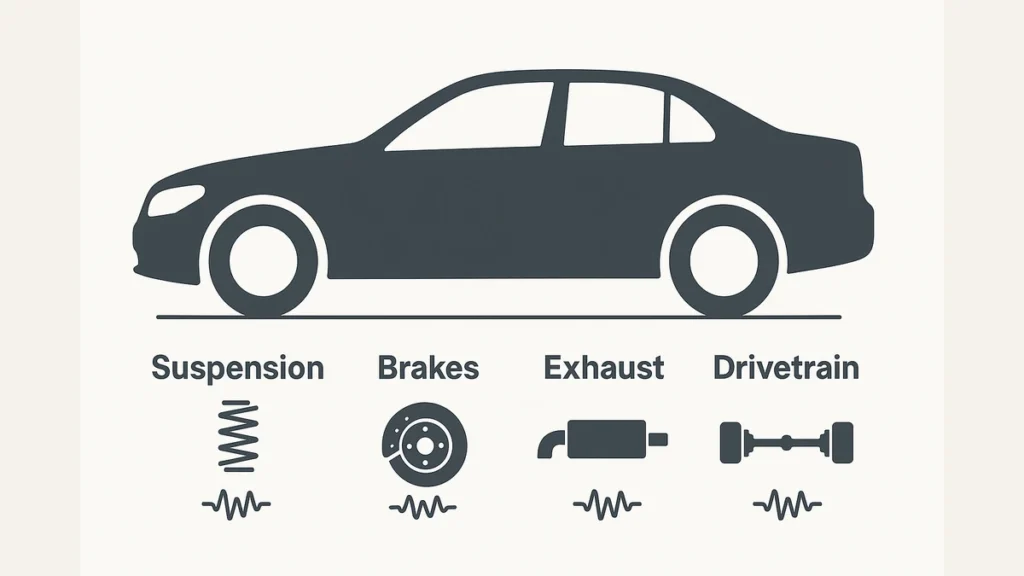
Table of Contents
Summary: Under-car noises usually come from the suspension, brakes, exhaust, or drivetrain. The trick is to note what the sound is, when it happens, and where it seems to come from. This guide walks you through quick checks, likely causes, urgency levels, and safe next steps—so you can decide whether it’s a DIY fix, a “soon” repair, or a stop-driving-now situation.
1) Quick Answer: Noise → Cause → Urgency
| What you hear | When you hear it | Likely source | Why it happens | Urgency |
|---|---|---|---|---|
| Rattle/metallic chatter | Idle or low RPM; over bumps | Heat shield, loose exhaust clamp, loose jack/spare or undertray | Thin shields vibrate; fasteners rust/loosen | Soon (secure/replace) |
| High-pitched squeak | Small bumps, driveway entries | Sway bar bushings/links, control-arm bushings, strut top mounts | Rubber dries/cracks; ball-and-socket wear | Soon |
| Heavy clunk/thud | Big bumps; speed humps | Ball joint, control arm, shock/strut mount | Excess play allows parts to knock | Priority (safety) |
| Click-click on turns | Low-speed tight turns (esp. FWD) | Outer CV joint | Worn joint under steering angle | Priority |
| Grinding that follows wheel speed | While driving, gets louder turning one way | Wheel bearing | Damaged bearing races | Priority (can fail) |
| Grinding when braking | During pedal application | Worn pads/rotors, stuck caliper, stone in dust shield | Metal-on-metal | Stop (risk to brakes) |
| Scraping/dragging | Constant or after hitting something | Bent splash shield, undertray dragging | Panel contacts road/rotor | Soon → Stop if severe |
| Boomy drone / loud exhaust | Cruising or accelerating | Leaking muffler/resonator, cracked pipe | Holes/loose hangers | Soon |
| Whine on accel / decel | With throttle changes | Differential/gearbox | Gear wear/bearing noise | Soon → Priority |
| Thud when shifting / on-off throttle | Start/stop, gear changes | Engine/trans mounts, driveshaft U-joint | Excess play | Priority |
| Water slosh | Taking off/turning after AC use | AC condensate pooling (clogged drain) | Drain tube blocked | Soon |
| Pinging after shutdown | Engine off, cooling down | Exhaust cooling | Normal metal contraction | Normal |
2) How to Narrow It Down (When/Where/What)
- When:
- Only when braking → think brakes.
- Only on bumps → suspension/steering.
- In a straight line with speed → wheel bearing/tires/driveline.
- Only on turns → CV joints, wheel bearing load.
- At idle/low RPM → exhaust shields, loose parts.
- Where: Left/right? Front/rear? Sit a passenger in the back to help localize. Sounds often telegraph through the cabin—trust your ears, but confirm visually.
- What sound: Rattle, clunk, squeak, grinding, scraping, drone, whine, click. Matching the “timbre” is half the diagnosis.
3) Suspension & Steering Noises
Squeaks over small bumps
- Likely: Sway bar bushings/links, control-arm bushings, strut mounts.
- Why: Rubber dries, cracks, or the joint loses lubrication.
- Checks: Look for torn boots, leaking struts, dry/cracked bushings. Bounce each corner; listen.
- Fix: Replace affected bushings/links; avoid petroleum lubes on rubber—use silicone if specified.
Clunk/thud on big bumps
- Likely: Worn ball joints, control arms, strut/shock mounts; sometimes broken coil spring ends.
- Why: Excess play lets metal hit metal.
- Urgency: High—failed joints can affect steering/safety.
- Checks: Wheel off ground; rock tire at 12/6 and 3/9 o’clock; look for play (pros use pry bars/ dial indicators).
- Fix: Replace worn joints/arms; align afterwards.
Groan/popping while turning at parking speeds
- Likely: CV joints (FWD/AWD), strut bearings at the top mount.
- Clue: Outer CV clicks when turning; inner CV shudders under acceleration.
- Fix: Replace joint/axle; inspect torn CV boots (grease loss is the root cause).
4) Brake Noises
Light squeal at low speed
- Likely: Wear indicators touching the rotor, or glaze on pads.
- Fix: Inspect pad thickness; replace pads/rotors as needed; clean and lube slider pins (proper brake grease).
Metallic grinding while braking
- Likely: Pads worn to backing plate, or a stone trapped between rotor and dust shield.
- Urgency: Stop driving—you can ruin rotors/calipers quickly.
- Fix: Replace pads/rotors; free the dust shield if bent.
Rattle after brake job
- Likely: Missing anti-rattle clips or loose caliper hardware.
- Fix: Refit hardware kit; torque to spec; use thread locker where required.
5) Exhaust System Noises
Rattle/chatter at idle
- Likely: Heat shield around the catalytic converter/mid-pipe, or loose clamp/hanger.
- Why: Thin stainless shields corrode at spot welds and buzz.
- Fix: Replace fasteners/shields; do not remove critical shields—they protect the car and nearby materials from heat.
Boomy drone or sudden loudness
- Likely: Muffler/resonator failure, broken gasket, cracked flex pipe.
- Clue: Gets louder with throttle; fumes smell stronger.
- Fix: Repair/replace sections; check hangers to avoid stress cracks.
Sharp tick near engine that follows RPM
- Likely: Small exhaust leak at manifold/gasket.
- Note: You’ll hear it from below, but the leak is often higher up.
- Fix: Replace gasket/hardware; leaks can trip sensors and increase cabin fumes.
6) Drivetrain & Wheel Bearing Noises
Humming/growling with speed, changes when you turn
- Likely: Wheel bearing.
- Clue: Load shift makes it louder when turning slightly one way (loading the opposite side).
- Fix: Replace the bearing/hub assembly.
Clicks on acceleration or turning
- Likely: Outer CV joint.
- Fix: Replace affected axle/joint; inspect boots regularly to prevent recurrence.
Clunk on gear changes / on–off throttle
- Likely: Engine/trans mounts, driveshaft U-joint (RWD), differential bushing.
- Why: Excess play allows the drivetrain to shift and bang.
- Fix: Replace mounts/joints; verify driveline angles on lifted/modified vehicles.
High-pitched whine with throttle
- Likely: Differential/gearbox bearings or gear mesh.
- Fix: Check fluid level/condition; repairs may be specialized—don’t delay.
7) Plastic Shields, Interior Odds & “False Alarms”
Not every noise means a major failure.
- Undertrays & wheel-well liners: After curb or debris strikes, plastic panels can scrape or flap. Re-clip or replace.
- Spare tire/jack: Loose tools in the trunk can mimic suspension knocks. Secure them.
- Rocks in the brake shield: A small stone can make a huge metallic scrape; a quick reverse/forward can eject it, or bend the dust shield slightly away from the rotor.
- Fuel tank slosh: Normal when low on fuel; should not be extreme.
- A/C condensate slosh: If you hear water moving after using A/C, clear the evaporator drain tube (short, easy job on many cars).
8) When to Stop Driving
Stop and call a tow if you notice any of the following:
- Grinding brakes or the pedal sinks/spongy.
- Severe wheel-bearing growl or the hub gets too hot to touch.
- Driveline vibration that shakes the cabin, especially with clunks (possible U-joint failure).
- Tire contacting metal (broken spring, bent shield).
- Exhaust leak into the cabin (fumes/headache).
- Fuel leak smell or visible dripping.
Your safety—and your repair bill—both benefit from stopping early.
9) DIY Inspection Checklist (Safety First)
Warning: Never get under a vehicle supported only by a jack. Use quality jack stands on solid ground; chock wheels; wear eye/hand protection.
- Walk-around & shake test
- Check for dangling plastics, missing clips, loose undertray.
- Shake the exhaust (when cool) at each hanger—should feel secure, no metallic rattle.
- Wheel & tire check
- Torque lug nuts; inspect inner/outer sidewalls for cuts.
- Spin each wheel off the ground; listen for bearing roughness; feel for play at 12/6 and 3/9.
- Brakes
- Look through the caliper: pad thickness ≥ 3–4 mm.
- Inspect dust shields for contact points; remove stones.
- Suspension
- Look for torn boots on ball joints and tie-rods; oil leaks on shocks/struts; cracked bushings.
- Bounce each corner; listen for squeaks/clunks.
- CV axles (FWD/AWD)
- Torn CV boots sling grease; clicking on turns points to the outer joint.
- Mounts & driveline
- With hood open, gently blip the throttle in “Drive” (foot on brake) and in “Reverse” (automatic) or rock the engine (manual in gear clutch in). Excess engine movement suggests worn mounts.
- RWD: Inspect driveshaft U-joints for play/rust trails.
- Exhaust leaks
- Look for sooty marks around joints/flanges; listen for tick or drone.
- Check flexible coupling for frays/cracks.
If anything looks doubtful, book a professional inspection and bring your notes (noise type, when it happens, conditions).
10) Preventive Maintenance
- Wash the undercarriage after winter or off-road trips; salt and mud trap moisture and accelerate bushing/fastener rust.
- Replace worn bushings and links before they get sloppy enough to knock.
- Service brakes annually: clean/lube sliders, replace hardware, measure pads/rotors.
- Check exhaust hangers; replace cracked rubber donuts before pipes stress-fracture.
- Use correct lubricants: silicone for rubber where specified; avoid petroleum grease on rubber bushings unless they’re polyurethane and the product calls for it.
- Mind wheel torque after tire rotations; loose wheels clunk and are dangerous.
- Inspect after pothole/curb strikes—a quick look can catch a bent shield or broken spring early.
11) FAQ
Q1: My car rattles underneath only at idle—what now?
Check heat shields and exhaust brackets first. Lightly tapping shields (engine off, cool) often reproduces the sound. Replace missing fasteners or the shield itself.
Q2: I hear a clicking sound when turning in a parking lot.
Classic outer CV joint symptom—especially on front-wheel-drive. Inspect CV boots for tears; plan a joint/axle replacement.
Q3: There’s a humming that gets louder with speed and changes when I steer slightly.
Likely a wheel bearing. Don’t wait—bearings can overheat and fail. Have it inspected and replaced.
Q4: My brakes squeal but pads look thick.
Glazed pads/rotors or missing anti-rattle clips can squeal. A proper brake service (deglaze/replace hardware) usually resolves it.
Q5: Can I spray something to stop bushing squeaks?
Temporary sprays rarely last and some damage rubber. Use the right grease only where specified, or replace worn bushings for a lasting fix.
Q6: Is a boomy exhaust harmful?
Besides noise violations, leaks can allow fumes into the cabin and may affect engine sensors. Fix leaks and broken hangers promptly.