Samsung Galaxy XR Review: The First Android XR Headset With Gemini AI
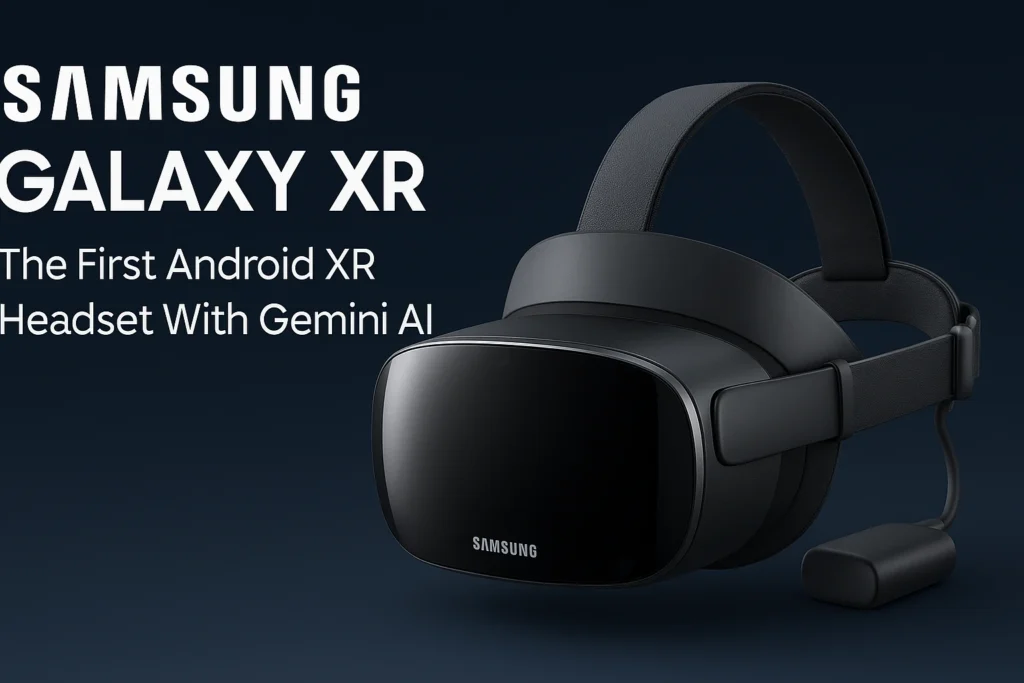
Table of Contents
TL;DR
The Samsung Galaxy XR is the company’s bold entry into mixed reality — a headset built in collaboration with Google and Qualcomm, powered by the Snapdragon XR2+ Gen 2 chip, and running the new Android XR platform. At a launch price of US$1,799, it undercuts the Apple Vision Pro by about half the price. With multimodal AI (voice + vision + gesture) built in via Google’s Gemini, dual 4K micro-OLED displays, detachable battery pack, and a design optimized for daily extended wear, the Galaxy XR marks a serious first step in Samsung’s XR strategy. If you’re a tech-enthusiast, XR early adopter, or looking for a “computer for your face,” this merits serious consideration. But it’s not without trade-offs — battery life is limited (~2.5 hours), and XR apps are still early.
(Word count so far: ~200)
1. The Big Picture: Why Samsung & Android XR Matter
The XR (extended reality) market — blending virtual reality (VR), augmented reality (AR) and mixed reality (MR) — has long promised “the next computing platform.” But uptake has languished. Market-research firm Gartner estimates the head-mounted display market will grow only ~2.6% to $7.27 billion next year. Reuters+1
Into this slow-moving segment steps Samsung, armed with a major strategic shift: instead of a closed proprietary OS, the company co-developed Android XR with Google and built the Galaxy XR as its first device. Samsung Global Newsroom+2Samsung Global Newsroom+2
Why this matters
- Open ecosystem: By leaning on Android XR and the OpenXR standard, Samsung makes it easier for developers to bring mobile apps and XR experiences into one platform. Samsung Global Newsroom+1
- AI built in: With Gemini AI embedded at the system level, the device isn’t just a display-wired headset—it’s aiming to become a “companion.” Samsung Global Newsroom+1
- Price advantage: At $1,799, it undercuts hi-end XR rivals (Apple Vision Pro list price ~US$3,499) by a wide margin, making it potentially more accessible. Reuters+1
In short: Samsung isn’t just releasing a new headset—they’re launching the first salvo of a multi-device XR ecosystem (headset → glasses → other form-factors) built on Android XR. Samsung Global Newsroom
2. Galaxy XR: Core Specifications & Hardware Breakdown
Here are the key features you need to know about the Galaxy XR.
Processor & Platform
- Chipset: Snapdragon XR2+ Gen 2 from Qualcomm, built specifically for XR workloads. Samsung Global Newsroom+1
- Operating system / Platform: Android XR (jointly developed with Google) with Gemini AI embedded. Samsung Global Newsroom+1
Display, Resolution & Field of View
- Dual micro-OLED displays; resolution ~3,552 × 3,840 per eye (total ~27 million pixels). Samsung Global Newsroom+1
- Refresh rate support: up to 90 Hz, with default ~72 Hz. Samsung Global Newsroom+1
- Field-of-view: approx. 109° horizontal × 100° vertical. ويكيبيديا+1
Memory, Storage & Battery
- Memory: 16 GB RAM, 256 GB storage. ويكيبيديا
- Battery: External battery pack (separate from head-unit) to reduce weight; Samsung quotes ~2.5 hours of use under test conditions. Samsung Global Newsroom+1
Tracking & Input
- Inside-out head-tracking, hand-tracking, eye-tracking sensors. Samsung Global Newsroom+1
- Cameras: Pass-through cameras let you see the real world and “circle to search” objects with your hand. Samsung Global Newsroom+1
Design & Comfort
- Ergonomically designed frame: pressure balanced across forehead and back of head for extended wear. Samsung Global Newsroom
- Detachable light-shield (for deeper immersion) and separate battery pack helps reduce head-weight. Samsung Global Newsroom
Price & Availability
- Launch price: US$1,799.99. Samsung Global Newsroom+1
- Available: October 21 (USA) / October 22 (Korea) initial availability. Samsung Global Newsroom+1
3. Real-World Use Cases: Discover, Work, Play
What can you actually use the Galaxy XR for in daily life, beyond the “look how cool it is” factor?
A) Immersive Discovery & Creativity
- With Gemini embedded, you can ask for directions in Google Maps, get real-world context via pass-through view, and search objects around you simply by “circling” them with your hand. Samsung Global Newsroom
- Photo and video memories: 2D content can be auto-spatialized into 3D via Google Photos support. Samsung Global Newsroom
B) Productivity & Work
- Because it runs Android apps out-of-the-box, you could load familiar productivity tools (Word, Sheets, etc) and use the headset as a virtual monitor. Samsung emphasises use in enterprise training (e.g., ship-building training with Samsung Heavy Industries). Samsung Global Newsroom
- Multitasking: Stream content, set virtual workspaces, view multiple “screens” in immersive space.
C) Gaming & Entertainment
- Dual 4K displays + eye tracking + hand-tracking = high potential for next-gen immersive gaming. Samsung highlights sports viewing (“feel like you’re in the stadium”) and 3D edits via Adobe integration. Samsung Global Newsroom
- VR / MR experiences: The platform supports both virtual worlds (fully immersive) and mixed-reality modes (blend of real world + digital overlay).
D) Enterprise & Training Applications
- Samsung is explicitly targeting enterprise use (training, remote collaboration, design). Example: they partnered with Samsung Heavy Industries for virtual ship-building training via Galaxy XR. Samsung Global Newsroom
- The open ecosystem (Android XR + OpenXR) may make enterprise development faster & less locked into one vendor.
4. Comparison: Galaxy XR vs Apple Vision Pro vs Meta (Quick Snapshot)
Here’s how the Galaxy XR stacks up in the broader XR landscape.
| Device | Launch Price | OS / Platform | Strengths | Weaknesses |
|---|---|---|---|---|
| Samsung Galaxy XR | US$1,799 | Android XR | Lower price, Google/Qualcomm backing, open ecosystem | Battery life ~2.5 h, first-gen device |
| Apple Vision Pro | US$3,499+ | visionOS | Premium build, strong ecosystem, apps | Very high price, closed ecosystem |
| Meta Quest Series* | Varies (≈US$499-$999) | Meta Quest OS | Mass-market, strong content library | Less premium hardware & optics |
* For Meta, this is a rough comparison, since many are VR-centric rather than full MR with passthrough + eye-tracking.
Key points
- Samsung’s major advantage is price with premium ambition: For ~half the price of Vision Pro, you get a top-tier specification and Google integration. Reuters+1
- On the flip side, Vision Pro still benefits from more mature content, stronger brand in this space, and likely better battery/optimization (though that remains to be truly tested side-by-side).
- Meta remains a leader in volume and content, but Samsung is shooting for the “premium tech” segment. The open Android XR platform may give Samsung more flexibility with developers.
5. Strengths & Weaknesses (Honest Take)
✅ What the Galaxy XR does well
- Outstanding display & optics for the price (dual 4K micro-OLED).
- Advanced input methods: voice, gestures, eye tracking, hand tracking.
- Great partner ecosystem (Samsung hardware + Google AI + Qualcomm chip).
- Comfortable and thoughtful design (detachable battery, light-shield, ergonomic frame).
- Open platform means more app/experience potential over time.
⚠️ What you should consider
- Battery life: ~2.5 hours quoted is modest compared to expectations for daily all-day use. Real-world may be less, especially with demanding XR apps.
- Content ecosystem is still nascent: While Android XR opens doors, dedicated XR-optimized app catalogue is smaller compared to VR/AR ecosystems that have been building for years.
- Form factor / weight: Although improved, head-mounted displays still impose physical load compared to standard monitors or tablets. The separate battery helps, but cable tethering or battery swap may be needed.
- Price is still high for many consumers: US$1,799 is accessible compared to some rivals but is still premium.
- Software maturity: Being first gen, there may be refinements in future iterations (e.g., wireless battery, lighter glasses).
6. Who Should Buy It — And Who Should Wait?
Get it if you:
- Are an early adopter of XR / MR tech and want cutting-edge gear now.
- Want a device that blends productivity, entertainment and immersive experiences rather than just gaming.
- Already comfortable with premium tech price points and don’t mind early-stage ecosystem trade-offs.
- Prefer the Android ecosystem (Google services, apps) and want a more open platform.
Hold off (or wait) if you:
- Use for casual tasks and expect battery to last full day without recharge.
- Are heavy on content and want a large mature library of XR apps right now.
- Are price-sensitive and prefer waiting for next-gen lighter hardware (glasses form-factor) or more affordable versions.
- Are strictly into gaming only, where ultra-high refresh rate and wired console/PC setups still dominate.
7. Buying & Setup Tips
- Pre-order or buy early to secure bundle offers: Samsung is offering a year of Google AI Pro + YouTube Premium + Play Pass for initial buyers. Reuters+1
- Ensure your play space: Even though Galaxy XR supports inside-out tracking, you’ll want a safe area free of obstacles for gestures and movement.
- Accessorize: Consider comfort accessories (head-pads, strap upgrades), extra battery packs, and a carrying case if you travel with the headset.
- App readiness: Install Android apps optimised for XR, check updates for Gemini and Android XR platform to ensure best experience.
- Use tether or stand-alone? Decide whether you’ll use the headset wired to a PC (if supported) or fully standalone. The separate battery pack helps in mobile mode.
- Clean the lenses regularly, as optical clarity is a key feature; micro-OLED displays benefit from meticulous setup.
8. Future Outlook & What to Expect Next
Samsung has openly stated that the Galaxy XR is “the first step” in its XR roadmap. The company and its partners (Google and Qualcomm) plan lighter devices — notably XR glasses, fashion-forward form factors (via partnerships with Warby Parker & Gentle Monster) — running on the same Android XR platform. Samsung Global Newsroom
Expect the following developments:
- Glasses form-factor: Ultra-light weight, prescription-friendly, possibly no separate battery pack.
- Improved battery and wireless freedom: On-board battery, wireless battery swap or hot-plug solutions.
- Ecosystem growth: More XR-optimized apps, enterprise use-cases, developer tools via OpenXR.
- Lower pricing tiers: As hardware matures and economies of scale improve, more accessible versions (e.g., <$1,000) may emerge.
- Mixed reality work workflows: With AI/vision, more immersive collaboration, remote presence, training and design tools will become mainstream.
In other words: If you’re willing to buy now, you’re getting a “future-proof platform” rather than just a device. If you wait, you might get lighter hardware and lower price, but you’ll miss first-mover benefits.
9. Final Verdict
The Samsung Galaxy XR is a bold and compelling entry into the XR space. With high-end hardware, a strong partner ecosystem (Samsung + Google + Qualcomm), and a competitive price for what it offers, it stands out in this emerging category. While battery life and content ecosystem remain points to watch, the device delivers more than just “another VR headset.” It positions XR as a practical next-step in personal computing — where work, play and discovery merge.
If you’re ready to step into the XR world now, prefer Android/Google services, and are willing to accept some early-stage trade-offs, the Galaxy XR is a very strong choice. If you’re less certain or budget-conscious, waiting for next-gen iterations might be wise.
FAQ
Q1: What is the Samsung Galaxy XR?
It’s Samsung’s first mixed-reality headset built in collaboration with Google and Qualcomm, and the first device running the Android XR platform. Samsung Global Newsroom+1
Q2: What does “Android XR” mean?
Android XR is a new operating platform developed by Google and Samsung for extended reality devices (XR), integrating native AI (Gemini), gesture/eye tracking, and designed to scale across headsets, glasses and future form factors. Samsung Global Newsroom+1
Q3: How much does the Galaxy XR cost and when is it available?
It launches at US$1,799 and becomes available October 21 (US) and October 22 (Korea) initially. Samsung Global Newsroom+1
Q4: What are the key hardware specs?
Key specs include dual micro-OLED 4K displays (~3,552×3,840 per eye), Snapdragon XR2+ Gen 2 processor, 16GB RAM, 256GB storage, eye/hand tracking, and a detachable battery pack for comfort. ويكيبيديا+1
Q5: How long does the battery last?
Officially up to ~2.5 hours under test conditions. Actual usage may vary based on app, brightness, tracking and connected features. Samsung Global Newsroom
Q6: Is it worth buying now?
If you’re an early adopter, want premium XR today, use Google/Android ecosystem, and are okay with early-stage trade-offs (battery, content maturity), then yes. If you’re more budget-sensitive or prefer mass-market maturity, you might wait.
Q7: How does it compare to Apple Vision Pro?
At half the price (~US$1,799 vs ~US$3,499+), Galaxy XR offers competitive hardware and the Android ecosystem. However, Apple has more mature software/market penetration; Samsung gains with open platform, Google services and lower cost. Reuters+1
Official Source / Press Release:
Samsung Newsroom – Introducing Galaxy XR: Opening New Worlds – https://news.samsung.com/global/introducing-galaxy-xr-opening-new-worlds Sa