
Car Engine Oil: Why It Matters, When to Change It, and How to Choose the Right Type
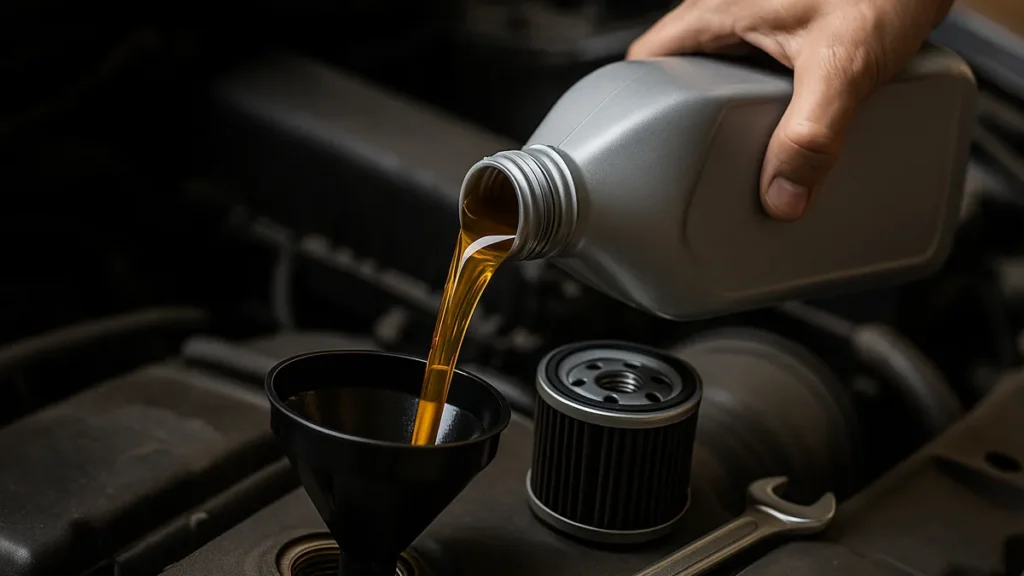
Table of Contents Engine Oil
Introduction: Small Maintenance, Big Protection
Engine oil is the thin film that keeps thousands of metal parts from grinding together. It lubricates, cools, cleans, and protects. Fresh, correct oil is one of the cheapest ways to extend engine life, maintain fuel economy, and prevent expensive repairs.
What Engine Oil Actually Does
- Lubrication: Reduces friction between moving parts (pistons, bearings, cams).
- Cooling: Carries heat away from hot zones that coolant can’t reach.
- Cleaning: Detergents and dispersants suspend soot, varnish, and combustion by-products so the oil filter can trap them.
- Sealing: Helps piston rings seal against cylinder walls for proper compression.
- Corrosion protection: Additives neutralize acids and protect metal surfaces.
When oil degrades (oxidizes, shears, or becomes contaminated), it can’t do these jobs well—wear increases, sludge forms, and temperatures rise.
Why Regular Oil Changes Matter
- Prevents sludge and varnish: Old oil thickens and leaves deposits that block tiny oil passages and stick rings or hydraulic lifters.
- Maintains fuel economy and performance: Fresh oil reduces internal drag, helping the engine run smoother and cooler.
- Extends engine life: Adequate lubrication prevents metal-to-metal contact—your insurance against premature wear.
- Protects turbochargers and timing components: Turbos spin at >100,000 rpm and depend on clean, high-quality oil; so do timing chains and variable valve timing (VVT) systems.
How often should you change oil?
Follow your owner’s manual or vehicle oil-life monitor. Typical ranges:
- Full synthetic: ~8,000–16,000 km (5,000–10,000 miles) depending on engine and driving pattern.
- Conventional/blend: ~5,000–8,000 km (3,000–5,000 miles) or annually.
- Severe service (short trips, extreme heat/cold, dusty roads, heavy loads, lots of idling): change sooner.
Tip: Time matters too—oil ages even if mileage is low. If you do short trips that never fully warm the engine, change by time (e.g., 6–12 months) rather than distance.
Understanding Viscosity (SAE Grades)
Viscosity is oil’s resistance to flow, shown as SAE 0W-20, 5W-30, 10W-40, etc.
- The number before W (“winter”) reflects cold-start flow. Lower is thinner in the cold (easier starts, faster protection).
- The number after W reflects thickness at operating temperature. Higher is thicker when hot (can help in high-temp or higher-mileage conditions, if approved by the manufacturer).
Always use a grade specified in your owner’s manual. Modern engines are tightly engineered around specific viscosities for emissions, fuel economy, and timing chain health.
Types of Engine Oil (and When to Use Each)
1) Full Synthetic Oil
What it is: Highly refined base oils with advanced additive packages.
Best for: Modern engines, turbocharged cars, extreme temperatures, extended intervals.
Benefits:
- Excellent high- and low-temperature performance
- Better oxidation stability (resists breakdown)
- Cleaner operation (fewer deposits)
- Often improved fuel economy
2) Synthetic Blend (Semi-Synthetic)
What it is: Mix of conventional and synthetic base oils.
Best for: Budget-friendly step up from conventional; light towing, mixed driving.
Benefits:
- Improved protection vs. conventional
- Better cold starts and heat resistance
- Usually cheaper than full synthetic
3) Conventional (Mineral) Oil
What it is: Refined petroleum with additive package.
Best for: Older engines designed for it; short intervals; mild use.
Benefits:
- Lower cost
- Adequate protection for simple, older designs with frequent changes
4) High-Mileage Oil
What it is: Usually a synthetic blend with seal conditioners and extra detergents.
Best for: Engines with >120,000 km (75,000+ miles) showing minor seepage or consumption.
Benefits:
- Helps recondition hardened seals
- Additives target wear and deposits common in older engines
5) Diesel Engine Oil (HDEO)
What it is: Formulated for diesel soot control, higher loads, and different emission systems. (Labels like API CK-4, FA-4.)
Best for: Diesel passenger vehicles and trucks (use only if your engine requires it).
Benefits:
- Robust detergency/dispersancy
- Shear-stable for heavy loads
- Protects after-treatment devices when correct spec is used
6) Specialty/Euro Oils
What it is: Oils meeting specific ACEA or manufacturer specs (e.g., VW 504/507, MB 229.5, BMW LL-17 FE+).
Best for: European makes and models with strict ash/long-life requirements.
Benefits:
- Precisely matched to emission systems, long drains, and fuel economy targets
Additives 101: What’s Inside the Bottle
- Detergents & dispersants: Keep contaminants suspended to prevent sludge.
- Anti-wear (e.g., ZDDP): Forms protective film on metal under high pressure.
- Friction modifiers: Help fuel economy and smooth operation.
- Anti-oxidants: Slow oil breakdown from heat and oxygen.
- Anti-foaming agents: Maintain stable oil pressure.
- Corrosion inhibitors: Protect internal surfaces.
Aftermarket additive “boosters” are usually unnecessary and can upset the carefully balanced chemistry of a quality oil. Choose the right oil spec instead.
Reading the Label: API/ILSAC/ACEA & OEM Specs
- API (e.g., SP) and ILSAC (e.g., GF-6) mark modern gasoline standards for protection, deposits, timing chain wear, and LSPI (for small turbo engines).
- ACEA (A/B, C categories) common on European oils.
- OEM approvals (GM dexos, VW/Audi, BMW, Mercedes-Benz, etc.) can be mandatory to keep warranties and emission systems healthy.
Rule #1: Match the viscosity and the specifications your manual requires.
How to Choose the Right Oil (Step-by-Step)
- Check the owner’s manual (or under-hood label) for viscosity and required specs.
- Consider your climate: colder climates favor 0W/5W; very hot climates or heavy use may allow higher hot grades (xW-30/40)—only if listed in the manual’s chart.
- Assess your driving pattern: lots of short trips, idling, towing, or stop-go traffic → prefer full synthetic and shorter intervals.
- Mileage & condition: minor leaks/consumption → try high-mileage oil of the specified grade.
- Engine type: turbocharged, direct-injection, diesel, or European? Choose oils approved for those systems.
Signs It’s Time to Change Oil (Beyond the Odometer)
- Oil-life monitor or service reminder indicates change due.
- Dark, gritty oil on the dipstick (color alone isn’t definitive, but grit is a red flag).
- Unusual engine noise at start-up or under load.
- Fuel economy drop or sluggish performance.
- Frequent short trips (engine rarely fully warms): change by time (e.g., 6 months).
Quick DIY Checklist (If You Change Oil Yourself)
- Correct oil grade/quantity and a quality filter (OEM or equivalent).
- Warm engine briefly for better drain; park level; use jack stands if lifting.
- Replace the drain-plug washer if required; torque to spec (don’t overtighten).
- Lightly oil the new filter gasket; hand-tighten per instructions.
- Fill measured amount, run engine 30–60 seconds, check for leaks.
- Shut off, wait a few minutes, check dipstick and top up to full mark.
- Reset the oil-life monitor; record mileage/date.
Dispose of used oil and filter responsibly at a recycling center or auto shop.
Common Myths, Debunked
- “Once synthetic, always synthetic.” False—mixing won’t destroy your engine. But it’s best to stick with one type/brand and correct spec.
- “Thicker oil is always better for older engines.” Not necessarily. Too thick can starve tight passages and VVT systems. Use grades approved by the manual; consider high-mileage formulations instead.
- “Color tells all.” Oil darkens quickly as it cleans; rely on intervals, specs, and your oil-life monitor.
FAQs Engine Oil
Q1: Can I switch from conventional to synthetic?
Yes. If your manual allows the same viscosity/spec, switching to synthetic is safe and often beneficial.
Q2: Do I need high-mileage oil at 120,000 km (75,000 miles)?
It helps if you notice minor leaks or consumption. If your engine is dry and healthy, it’s optional.
Q3: Is changing the oil filter every time necessary?
Yes. The filter captures contaminants and its bypass/anti-drainback valves age with heat cycles.
Q4: Can I extend intervals with synthetic?
Only if your manual permits and your driving is mostly highway with fully warmed trips. Severe service still shortens intervals.
Q5: My engine is noisy on cold starts—use thicker oil?
First, verify the correct spec and a high-quality filter with a good anti-drainback valve. Don’t change viscosity unless the manual allows it.
Conclusion: The Right Oil, Changed on Time
Choosing oil isn’t complicated: follow the manual, pick the correct spec and viscosity, and adjust intervals for your climate and driving. Regular changes with quality oil and filters keep your engine clean, cool, efficient, and protected—saving you money and headaches for years to come.





One Comment