Apple M4 Chip: Everything You Need to Know About Apple’s Latest Processor in 2025
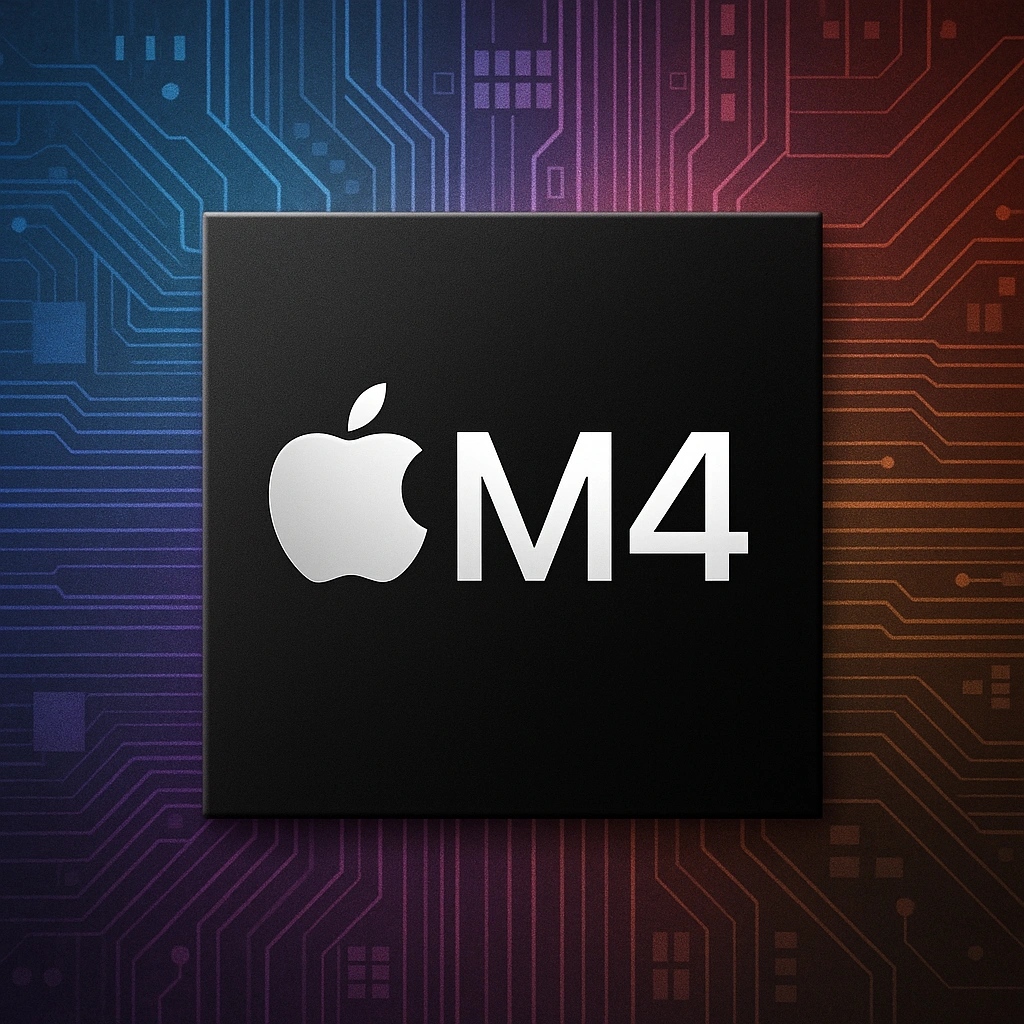
Table of Contents
Introduction: A New Era of Apple Silicon
When Apple first announced its transition from Intel processors to its in-house Apple Silicon back in 2020, few expected how quickly the company would redefine the laptop and desktop market. The M1 chip shocked the industry with its efficiency and performance, followed by the M2 and the game-changing M3 series.
Now, in 2025, Apple has taken things even further with the Apple M4 chip. As the latest Apple processor, the M4 brings next-generation CPU and GPU cores, cutting-edge power efficiency, and enhanced AI acceleration. Whether you’re a casual MacBook Air user or a professional running 8K video edits on Final Cut Pro, the M4 lineup delivers unmatched power.
In this expanded guide, we’ll explore everything about the Apple M4 chip: its specs, performance benchmarks, comparisons with Intel and AMD, device compatibility, and even future predictions about the rumored M5 chip.
What Makes the Apple M4 Chip the Latest Breakthrough?
Built on Advanced 3nm Technology
The Apple M4 is manufactured using TSMC’s 3nm process, allowing Apple to pack billions more transistors into the chip compared to the M3. This means better performance at lower power consumption, translating into faster computing while keeping MacBooks cool and long-lasting.
Unified Memory Architecture (UMA)
Apple continues to refine its Unified Memory Architecture, where RAM, CPU, and GPU share the same pool of memory. This eliminates bottlenecks common in traditional PC architectures and delivers blazing-fast performance, especially in graphics-intensive tasks.
AI and Machine Learning at the Core
With AI taking center stage in 2025, Apple designed the M4 with a more powerful Neural Engine. This makes the M4 highly optimized for AI-driven applications, from generative design to real-time translation and advanced photo/video editing powered by machine learning.
Apple M4 vs. M3: A Detailed Comparison
| Feature | Apple M3 | Apple M4 | Improvement |
|---|---|---|---|
| Process Technology | 3nm (first-gen) | 3nm (second-gen, refined) | More efficiency |
| CPU Cores | Up to 12 | Up to 14 | ~20% faster |
| GPU Cores | Up to 40 | Up to 48 | ~25% faster |
| Neural Engine | 16-core | 20-core | 30% faster AI tasks |
| Max RAM Support | 128GB | 192GB | Higher capacity |
| Battery Life | Excellent | Even better | Longer runtime |
The M4 not only beats the M3 in raw performance but also ensures sustained efficiency for long rendering sessions or gaming marathons without overheating.
Variants of the Apple M4 Chip
Just like previous generations, Apple has released multiple versions of the M4 to cater to different users:
Apple M4 (Base Model)
- Found in MacBook Air (2025) and entry-level MacBook Pro.
- Perfect for students, casual users, and office work.
- Delivers smooth multitasking with incredible battery life.
Apple M4 Pro
- More CPU and GPU cores.
- Targets professionals: developers, photographers, and engineers.
- Balanced power and efficiency for heavy apps like Xcode and Logic Pro.
Apple M4 Max
- Designed for creators handling 4K/8K video editing, 3D modeling, and music production.
- Packs maximum GPU cores for ultimate performance.
- Supports higher RAM configurations (up to 192GB).
Apple M4 Ultra (Expected)
- A beast-level processor likely to power the Mac Studio and Mac Pro.
- Uses Apple’s dual-die architecture for extreme computing.
- Competes directly with Intel Xeon and AMD Threadripper chips.
Real-World Performance: What Users Can Expect
Everyday Usage
For regular users browsing Safari, streaming content, or working on documents, the M4 MacBook Air feels instant. Apps open nearly instantly, and battery life can last over 20 hours in light usage.
Professional Workflows
- Video Editing: Final Cut Pro renders are up to 30% faster compared to M3.
- Photo Editing: Lightroom AI features and Photoshop filters process in real time.
- Coding & Development: Xcode builds complex apps significantly faster.
Gaming Performance
Gaming has traditionally been Apple’s weak spot. With the M4, GPU upgrades mean AAA titles optimized for Apple Silicon now run smoothly at high settings. While it won’t fully replace gaming PCs, the gap is closing.
Apple M4 vs. Intel and AMD: The Silicon Battle
Apple’s transition away from Intel wasn’t just about control—it was about performance per watt. Here’s how the M4 compares:
- M4 vs. Intel Core Ultra (2025): Apple’s chip outperforms Intel in energy efficiency, though Intel maintains compatibility with a wider range of software.
- M4 vs. AMD Ryzen AI Series: AMD’s chips shine in gaming desktops, but Apple dominates in laptops and creative tasks.
- M4 vs. NVIDIA GPUs: Apple’s integrated GPUs can’t yet fully replace dedicated NVIDIA RTX cards in professional gaming rigs, but they’re highly optimized for Apple’s ecosystem.
Apple M4 in Mac Devices
MacBook Air (M4, 2025)
Ultra-thin, fanless design, and unbeatable battery life. The M4 makes it the perfect student or business travel companion.
MacBook Pro (M4, M4 Pro, M4 Max)
Available in 14-inch and 16-inch models, offering professionals the power to handle complex creative workflows without compromise.
iMac (M4)
Expected to feature stunning performance with a sleek design, making it the ultimate all-in-one desktop for households and offices.
Mac Studio & Mac Pro (M4 Ultra)
For high-end professionals and enterprises, Apple’s M4 Ultra will likely redefine workstation performance.
Practical Use Cases of the Apple M4 Chip
- Content Creators: Faster rendering, smoother playback, and real-time effects.
- Developers: Compile large projects in Xcode in record time.
- Business Professionals: Effortless multitasking with spreadsheets, presentations, and video calls.
- Students: Lightweight devices like MacBook Air with all-day battery life.
- AI Enthusiasts: Superior performance for machine learning and AI-based tools.
The Role of AI in the M4 Generation
AI is no longer optional—it’s essential. With its upgraded Neural Engine, the M4 chip accelerates:
- Generative AI apps (image generation, AI video editing).
- Natural language processing for real-time translation.
- Advanced productivity tools like auto-summarization and smart presentations.
Apple’s integration of on-device AI ensures data privacy and speed, a key differentiator against cloud-reliant competitors.
Apple M4 vs. M4 Pro vs. M4 Max
| Feature | M4 | M4 Pro | M4 Max |
|---|---|---|---|
| CPU Cores | 10 | 12 | 14 |
| GPU Cores | 16 | 24 | 48 |
| RAM Support | 32GB | 64GB | 192GB |
| Best For | Everyday use | Professionals | Creators/Studios |
This tiered system allows Apple to target every segment of the market, from casual users to Hollywood studios.
Future of Apple Silicon: Is the M5 Coming Soon?
While the M4 is Apple’s latest chip in 2025, leaks suggest the M5 chip is already in development. Expected improvements include:
- Even more powerful AI accelerators.
- Enhanced ray-tracing GPU capabilities.
- Further refinements in 3nm or even 2nm process technology.
Apple’s roadmap makes it clear: the company wants complete independence and dominance in the computing market.
Frequently Asked Questions (FAQ)
1. Is the M4 chip faster than the M4 Pro?
No, the M4 Pro has additional cores and higher performance.
2. Is the M4 better than the M3 chip?
Yes, it delivers 20–30% performance gains with better efficiency.
3. Can I game on a Mac with the M4 chip?
Yes, many modern games run smoothly, especially those optimized for Apple Silicon.
4. Is Apple working on the M5 chip?
Yes, the M5 is in development, but the M4 is the newest available chip as of 2025.
Conclusion: The Apple M4 Chip Sets a New Standard
The Apple M4 chip is more than just another processor—it’s a statement of Apple’s leadership in modern computing. With powerful variants like the M4 Pro, M4 Max, and M4 Ultra, this generation delivers performance, efficiency, and AI readiness that rivals simply can’t match.
For anyone considering a new MacBook or iMac in 2025, the M4 chip ensures you’re getting future-proof performance built for both today’s workloads and tomorrow’s AI-driven applications.