Transmission Slipping: 11 Causes, Quick Tests & Fixes (Plus Costs & When to Stop Driving)
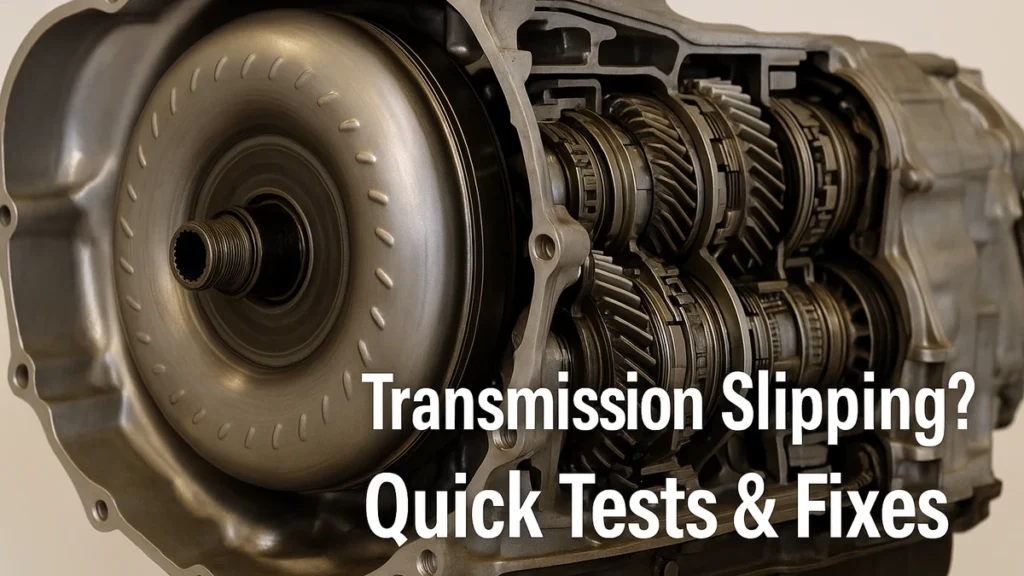
Summary (1-min read): Transmission slipping happens when engine RPM rises without a proportional increase in road speed, or when the gearbox hesitates, free-revs, shudders, or downshifts unexpectedly. This guide gives you safety rules (when to stop driving), quick driveway tests, the 11 most common causes with real-world fixes and costs, prevention habits, and clear FAQs.
Table of Contents: Transmission Slipping
What “Transmission Slipping” Feels Like
- RPM flare: Tach needle jumps during upshifts or steady cruise; speed doesn’t follow.
- Delayed engagement: Selecting D or R takes too long, sometimes followed by a thunk.
- Harsh or mushy shifts: Inconsistent feel—hard bang one time, soft slide the next.
- Shudder or surge: Buzzing vibration under light throttle, 40–80 km/h, often in lock-up.
- Poor acceleration / flare on kickdown: Pedal down, but gear can’t hold torque.
- Warning lights / limp mode: TCM or CEL turns on; vehicle locks into a safe gear.
Slipping can affect automatic, CVT, DCT/DSG, and manual transmissions. Manuals “slip” mostly due to clutch wear. This article focuses on autos/CVT/DCT with notes for manuals where it matters.
Quick Safety Checklist (When to Stop Driving Immediately)
Tow the car instead of driving if you notice any of the following:
- Burning smell from ATF or visible smoke from the engine bay/underbody.
- Metallic grinding/whining that gets louder with throttle or gear changes.
- Rapid fluid loss (fresh red or amber puddle), or fluid looks like glitter (metal).
- No drive or repeated limp mode, severe flare that prevents normal movement.
Driving through these symptoms can turn a $200 fix into a $2,000–$4,000 rebuild.
Fast DIY Checks (5–10 Minutes)
Before booking a shop, do these simple, noninvasive checks:
1) Fluid Level & Condition
- Warm the car per OEM; park level; cycle P→R→N→D→L then back to P.
- Check dipstick (if fitted) or follow the sealed unit check procedure (fill plug temp).
- Healthy ATF: clear red/amber, no burnt odor, no foam.
- Bad signs: dark brown/black fluid, burnt smell, foam (air), glitter (metal).
2) Scan for Codes (OBD2)
- A basic scanner can read P07xx range (e.g., P0700, P0730 incorrect gear ratio).
- Record freeze-frame data (speed, load, gear) so you can reproduce the condition.
3) Quick Leak & Cooler Check
- Inspect the pan gasket, axle seals, and cooler lines to the radiator/front stack.
- Look for dampness turning into active drip after a short drive.
4) Reproduce & Observe
- On a safe road, hold steady throttle at 60–90 km/h.
- Lock-up shudder (torque converter) feels like a low-frequency buzz; slight throttle change temporarily improves it.
- If slipping is gear-specific, suspect internal clutch pack damage or valve body issues.
The 11 Most Common Causes of Transmission Slipping
(Fixes + Typical Cost bands: $ < $150, $$ $150–$500, $$$ $500–$1,500, $$$$ $1,500–$5,000+)
- Low or Degraded ATF – $–$$
Why it slips: Low fluid reduces hydraulic pressure; burnt fluid lowers friction.
Fix: Top up with exact-spec fluid; if fluid is dark/burnt, drain & refill + filter. Avoid aggressive power flushes on old, unknown transmissions.
Expectation: Immediate improvement if caught early, especially on mild shudder/flare. - Wrong Fluid (ATF vs CVT/DCT Specific) – $–$$
Why: Additive packs and viscosity matter; wrong fluid causes shudder, flare, wear.
Fix: Correct-spec exchange (often 2–3 drain/refills for dilution on sealed units).
Pro tip: Many CVTs (e.g., Nissan/Jatco) and DCTs need proprietary blends—don’t guess. - Overheating / Weak or Clogged Cooler – $$
Why: Hot ATF thins → line pressure drops → clutches slip. Heat also accelerates oxidation.
Fix: Clean fins, replace kinked lines/thermostatic valves; consider an aux cooler for towing, mountain driving, or hot climates.
Clue: Symptoms worsen after long highway runs or uphill loads. - Worn Clutch Packs / Bands (Internal Wear) – $$$–$$$$
Why: Friction material wears out; seals lose integrity; apply pressure can’t hold torque.
Fix: Rebuild (new clutches, steels, seals) or replace with a reman unit.
Clue: Persistent, gear-specific slip even with fresh, correct fluid and no codes. - Failing Torque Converter (Lock-Up or Stator) – $$$
Why: Damaged lock-up clutch or stator reduces torque transfer; causes shudder and flare.
Fix: Replace converter; flush debris; verify cooler flow.
Clue: Shudder at steady speeds (60–100 km/h) that disappears with slight throttle change. - Valve Body Wear / Sticking Valves – $$–$$$
Why: Worn bores or varnish cause erratic pressure control and delayed clutch apply.
Fix: Clean/repair or replace valve body; sometimes a sleeved reman is best.
Clue: Problem is intermittent, worse hot, shows pressure control or shift solenoid codes. - Faulty Solenoids (Shift/Pressure) – $$–$$$
Why: Electrical/hydraulic failure disrupts timing/pressure.
Fix: Identify via scan tool actuation tests; replace single solenoid or pack. - TCM Software / Adaptation Out of Range – $–$$
Why: After wear, repairs, or battery loss, learned values become wrong.
Fix: Software update, adaptation reset and relearn per OEM; ensure pedal, brake switch, and temp readings are accurate for relearn. - Mechatronic Unit Failure (DSG/DCT) – $$$
Why: Integrated electronics/hydraulics fail; corrupt pressure/gear commands.
Fix: Repair/replace mechatronics, update software, flush to remove debris.
Clue: PRNDS flashing (on some VAG cars), odd clutch behavior, hot-only faults. - Internal Seals / Pump Wear / Pressure Loss – $$$–$$$$
Why: Age hardens seals; pump clearance grows; line pressure drops under load.
Fix: Rebuild with seals, bushings, and pump inspection; verify cooler bypass function. - Contamination (Metal Shavings / Debris) – $$–$$$$
Why: Debris clogs filters/valves, scratches bores, accelerates wear.
Fix: Multiple drain/refills, pan/magnet cleaning, filter, valve body service; severe cases need rebuild/replacement.
Costs at a Glance (Owner-Friendly Table)
| Service / Repair | Typical Cost | Difficulty | When It Makes Sense |
|---|---|---|---|
| ATF drain & refill + filter | $100–$350 | ●●○ | Fluid dark/burnt, mild slip/shudder, no metal |
| Full fluid exchange (OEM spec) | $200–$500 | ●●○ | Wrong/old fluid, early shudder, after overheating |
| Leak fix (pan gasket/lines/seals) | $120–$400 | ●●○ | Active drip or low fluid between services |
| Add auxiliary cooler | $150–$400 | ●●○ | Towing, hot climate, repeated overheat events |
| Solenoid (single/pack) | $200–$800 | ●●● | Codes for shift/pressure control, intermittent slip |
| Valve body repair/repl. | $400–$1,200 | ●●● | Erratic shifts, pressure faults, improves when cold |
| Torque converter | $700–$1,500 | ●●● | Lock-up shudder at cruise, RPM flare on light throttle |
| Rebuild (clutches/seals/pump) | $1,500–$3,500+ | ●●● | High mileage, gear-specific slip, worn clutches |
| Replacement/reman unit | $2,500–$5,000+ | ●●● | Severe contamination, cracked case, repeated failures |
| Manual clutch kit (note) | $300–$1,200 | ●●● | Manual only—engine revs rise under load, no pull |
Dots key: ● easy, ●● moderate, ●●● advanced/pro shop.
Targeted Diagnostics by Transmission Type
A) Conventional Automatic (Planetary + Torque Converter)
- Classic slip pattern: RPM flare during 2→3 or 3→4; delayed D engagement.
- Top suspects: Low/dirty ATF, valve body wear, torque converter lock-up, solenoids.
- Data to watch: Commanded gear vs. actual ratio, line pressure, TCC slip speed.
B) CVT (Belt/Chain & Variable Pulleys)
- Feel: High, steady RPM with poor speed gain; “rubber band” feel becomes extreme.
- Top suspects: Wrong/old CVT fluid, overheat, primary/secondary pulley pressure issues.
- Data to watch: Step motor commands, pulley ratio, CVT fluid temp.
- Extra note: Many CVTs are fluid sensitive—use the exact OEM spec.
C) DCT/DSG (Dual Clutch)
- Feel: Jerky takeoff, inconsistent clutch engagement, PRNDS flashing (some brands).
- Top suspects: Mechatronic unit, clutch packs, temperature-dependent pressure loss.
- Data to watch: Clutch adaptation values, requested vs. actual clutch pressure.
D) Manual (Bonus)
- Feel: Engine revs climb without speed under heavy throttle in high gears.
- Top suspects: Worn disc/pressure plate, oil contamination on disc, weak pressure plate.
- Simple test: 4th gear at low speed → full throttle; if revs jump without speed, clutch is slipping.
DIY Flowchart: From Symptom to Next Step
- Check fluid (level/condition) → correct or service.
- Scan codes → if P07xx present, address relevant circuit/pressure/ratio issue.
- Heat-related? Worse when hot → suspect cooler/pressure/valve body.
- Speed-specific shudder at cruise → suspect torque converter lock-up.
- Gear-specific slip → likely internal clutch/band wear → rebuild evaluation.
- Intermittent, improves when cold → valve body varnish/wear or solenoids.
- DCT odd behavior + warning → mechatronics/adaptation.
Prevention: Habits That Extend Transmission Life
- Use exact-spec fluid and change on time, especially for CVT/DCT.
- Keep it cool: Ensure cooler fins are clean; add aux cooler for towing/hot regions.
- Warm up smartly: Gentle driving for the first 5–10 minutes is better than long idles.
- Throttle discipline: Avoid repeated WOT from low speeds; don’t “power brake.”
- Towing etiquette: Respect limits; use tow/hauling mode; downshift on long descents.
- Fix leaks early: Low fluid cooks a healthy unit fast.
- Post-service relearn: After fluid or major work, do adaptation resets properly.
Case Examples (Quick Scenarios)
- Highway Shudder at 80 km/h, Light Throttle (No Codes):
Fresh OEM-spec fluid + friction-modified ATF for lock-up often helps; if persistent, replace torque converter and flush cooler. - Hot-Only Slip After Mountain Drive:
Cooler partially blocked; install aux cooler, service fluid, confirm temp drop on scan data. - CVT Drone with Poor Acceleration After “Universal ATF”:
Exchange for proper CVT fluid; reset CVT adaptives; symptoms frequently improve immediately. - Intermittent Delayed D Engagement, Better When Cold:
Valve body wear/varnish; pressure faults in logs; consider reman valve body and fresh filter.
FAQs : Transmission Slipping
Q1) Can I drive with a slipping transmission?
Short trips only to get to a shop—if there’s no burning smell, no metal noise, and no active fluid pour. Otherwise, tow it to prevent catastrophic damage.
Q2) Will a fluid change fix slipping?
It often helps when the cause is low/dirty or incorrect fluid. It won’t reverse heavy internal wear; expect improvement but not miracles.
Q3) Do “stop-slip” additives work?
They can reduce minor shudder temporarily. Treat them as a stop-gap, not a repair. Always diagnose the root cause.
Q4) How do I tell torque converter vs gearbox?
Converter issues show as lock-up shudder at steady speeds with RPM flutter; gearbox wear is more gear-specific and may log incorrect ratio codes.
Q5) Is rebuild or replacement better?
- Rebuild: Keeps original case; ideal if hard parts are reusable.
- Replacement (reman): Best for severe contamination/cracked case; often comes with warranty and latest updates.
Q6) Is a power flush safe?
Only on healthy units with recent service history. On neglected, high-mileage transmissions, do gentle drain/refill cycles with filter and magnet cleaning.
Q7) What’s the ideal interval for fluid changes?
Follow your OEM. As a rule of thumb: automatic 50–80k km, CVT/DCT 40–60k km—sooner under heat, towing, or city stop-and-go.
Quick How-To: Check Automatic Transmission Fluid (ATF) Correctly
Time: 5–10 minutes Tools: Paper towel, gloves, OBD2 scanner (optional)
Safety: Park level, set parking brake, keep clear of moving parts.
- Warm Up: Drive 10–15 minutes to reach the specified ATF temperature.
- Stabilize: With foot on brake, cycle P→R→N→D→L then back to P; keep engine idling.
- Access Dipstick/Plug: If sealed, follow service-manual temp and fill/check procedure.
- Read Level: Wipe dipstick, reinsert, then read; level must be within HOT marks.
- Assess Fluid: Healthy = clear red/amber, no burnt smell. Dark/burnt = service.
- Top Up Correctly: Add the exact spec in small increments; avoid overfill.
- Scan for Codes: Persistent slip? Scan for P07xx codes and note freeze-frame.